


Utah Prescribed Fire
Fire has always been part of the environment, and one of the most important natural agents of change. Fire plays a vital role in maintaining healthy ecosystems. Native Americans understood this and used fire to hunt game, maintain rangelands, and keep forests healthy.
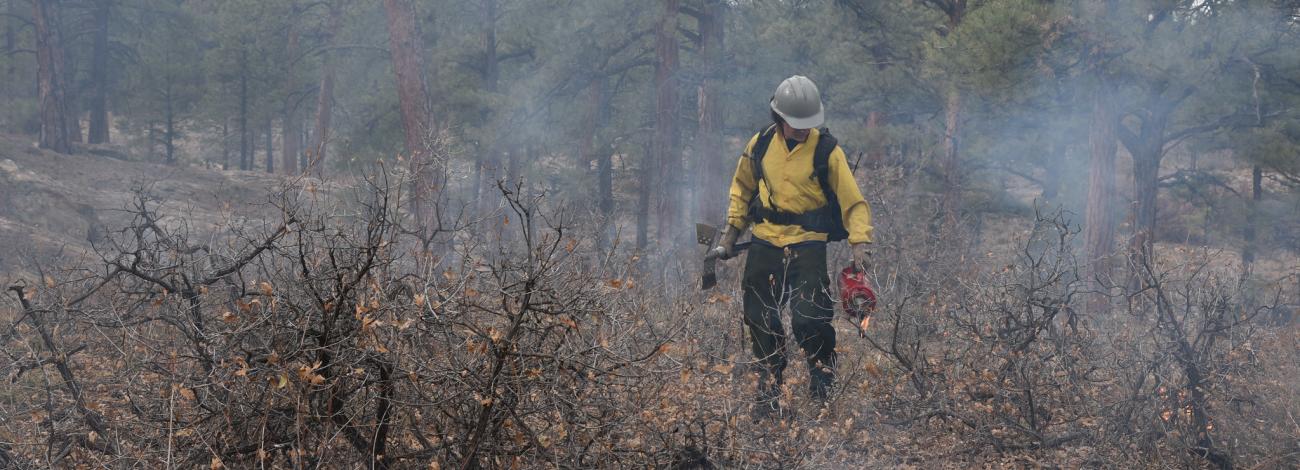
Prescribed fire is a planned fire. A prescribed fire is one of the most important tools used to reduce wildfire risk to communities, restore habitats, and to achieve land-management objectives. Fire management specialists consider objectives such as public and employee safety, weather, topography, fuels, size, the precise environmental conditions under which it will burn, and conditions under which it may be suppressed.
Prescribed fire is generally less expensive and yields ecological benefits that cannot be achieved by other means, such as mechanical thinning or logging. Prescribed fires restore some of the ecological benefits that were historically gained from naturally occurring fires. There are many potential goals that can be achieved by using prescribed fire. Here are a few examples:
- Reduce surface and ladder fuels that contribute to increased risk of uncharacteristically severe wildfire.
- Reduce risk local communities from wildfire.
- Help protect natural resources such as timber and critical habitat.
- Promote native species and reduce encroachment of invasive species.
- Enhance landscape resiliency and recovery from a wildfire event.
- Improve firefighter ability to safely and effectively respond to and suppress wildfire.
Prescribed Fires by District
All prescribed burns are carefully planned and only carried out when weather, fuel conditions, and air quality are within safe parameters. Firefighters use a combination of natural features and constructed control lines to keep the fire contained, with protocols in place to minimize smoke impacts on nearby communities.
Use this interactive map to find BLM district and field office boundaries in Utah.
Follow Utah Fire Info on Facebook for the most up-to-date fire information.
- Canyon Country District
Moab Field Office
East Coyote
Approximately 950 acres southeast of La Sal, Utah will be treated via pile burn throughout the fall, winter and spring as conditions allow, starting approximately November 3, 2026. Smoke may be visible from highways 46 and 191, as well as from the town of La Sal.Monticello Field Office
No prescribed fires are planned at this time.
- Color Country District
Cedar City Field Office
Shurtz Canyon
Approximately 150 acres in Shurtz Canyon, about 5 miles south of Cedar City, Utah, will be treated via pile burn throughout the fall, winter and spring as conditions allow, starting November 2026. Smoke may be visible around Cedar Highlands, Southview, Shurtz Canyon, parts of Cedar City, and near Old Highway 91, Tipple Road, and Interstate 15.Kanab Field Office
No prescribed fires are planned at this time.
St. George Field Office
No prescribed fires are planned at this time.
- Green River District
No prescribed fires are planned at this time.
- Paria River District
No prescribed fires are planned at this time.
- West Desert District
Fillmore Field Office
No prescribed fires are planned at this time.
Salt Lake Field Office
Kyune Creek
Approximately 1,205 acres northwest of Price, Utah will be treated via pile burn throughout fall, winter and spring in 2026 and 2027, as conditions allow. Smoke may be visible from Highway 6.