


Beyond the Badge: Protecting People and Public Lands
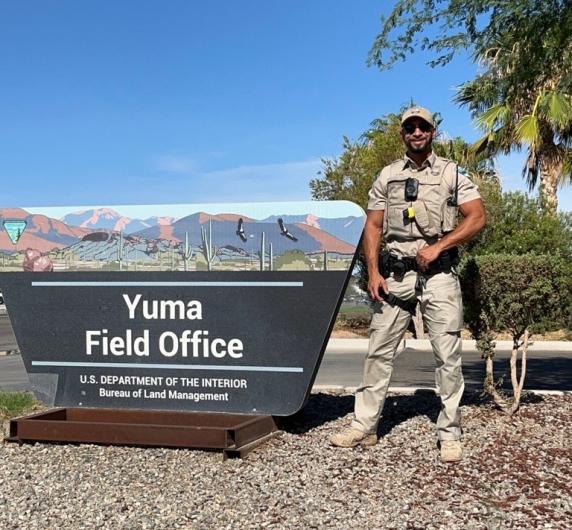
A routine patrol across public lands near Yuma, Arizona, can change in an instant.
Eric Cole knows that better than most.
Cole, a supervisory law enforcement ranger with the Bureau of Land Management’s Yuma Field Office, was once called into the desert after another hiker found an unconscious woman and called 911. She had apparently suffered an allergic reaction to an insect bite and, by the time Cole reached her, also appeared to be suffering from heat-related illness.
The terrain made getting a conventional ambulance directly to her impractical. Cole loaded her into his patrol vehicle, transported her across the backcountry and transferred her to an awaiting ambulance.
“What stays with me is how quickly a situation in the desert can become life-threatening,” Cole said. “If the hiker hadn’t found her, or if she had remained out there much longer, I don’t know whether she would have survived.”
For Cole, moments like that are part of a career spent being ready for whatever comes next. For BLM law enforcement rangers like him, being a first responder can mean bringing emergency response capabilities to places where traditional emergency vehicles may have difficulty reaching and where help can be many miles away.
As the nation recognizes National First Responders Day on October 28, Cole’s career provides a look at the people behind one part of the BLM mission that visitors may rarely see: law enforcement rangers who patrol vast stretches of public land and may suddenly find themselves among the closest trained responders when someone needs help.
Cole supervises BLM law enforcement rangers and Bureau of Reclamation rangers, but his supervisory responsibilities have not taken him out of the field. He still patrols public lands, makes visitor contacts, enforces federal laws and regulations, responds to emergencies and assists state, local and federal partners.
Staying involved in day-to-day field operations matters to him.
It keeps him connected to the work his rangers are doing and to the people who depend on them.
“In an emergency, sometimes it simply comes down to which trained first responder is closest,” Cole said. “On millions of acres of public land, that person can very easily be a BLM ranger.”
For Cole, responding to an emergency often begins with the challenge of simply reaching the person who needs help.
The Yuma Field Office manages approximately 1.2 million acres of public land. Cell service can be limited or nonexistent. A call may begin with a distress beacon, an SOS activation from a satellite-capable GPS device or an incomplete 911 call that provides only limited information about where someone is located or how to reach them. Locating the person can become part of the emergency response itself.
Years spent patrolling the backcountry have taught him the access routes, terrain and travel patterns across the area. Rangers may use vehicle tracks, footprints and other signs to help determine where someone has gone.
“Sometimes getting to the emergency is as challenging as dealing with the emergency once you arrive,” Cole said.
That reality shapes the way Cole prepares before he ever leaves for patrol.
He carries multiple ways to communicate and navigate, including handheld and vehicle radios, satellite communications, GPS, Starlink and phones operating on different cellular networks. His patrol vehicle is equipped with spare tires, recovery and extraction equipment and a winch.
For Cole, redundancy is not simply convenient. It is the principle that allows him to function when the nearest assistance may be a considerable distance away.
“We prepare for worst-case scenarios because, in the backcountry, a relatively minor problem can become a major one very quickly,” he said. “You have to be self-sufficient enough to deal with the unexpected while still being capable of helping the person who called you in the first place"
That same mindset carries over when Cole arrives first at an incident.
He requests and coordinates additional resources, but he also works from the assumption that those resources may not reach him immediately.
“You identify the problem in front of you, determine what resources you have and start working toward a solution,” Cole said.
Cole did not grow up planning to become a federal law enforcement officer.
He entered college intending to become a certified public accountant and began taking criminal justice courses as electives. At the University of Maryland, professors with extensive federal law enforcement and corrections backgrounds began changing the way he thought about his future.
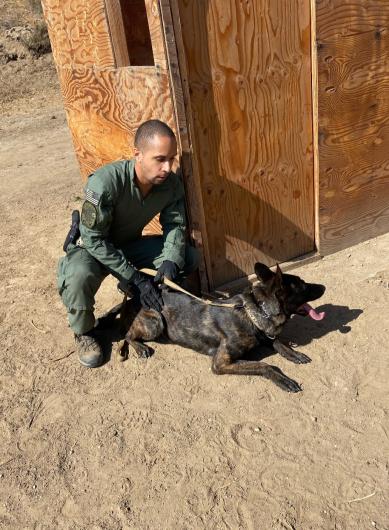
Then came a visit to a U.S. Secret Service training facility in Maryland.
Cole was about 20 years old when he participated in a training scenario in which he role-played as the president. He walked off a mock Air Force One with a protective detail, entered a simulated presidential limousine and experienced a scenario in which the motorcade came under attack.
The agents responded to simulated gunfire and conducted evasive maneuvers to move him out of the area.
The exercise left an impression. Something clicked.
“The combination of adrenaline, teamwork, responsibility and service during that experience made something click for me,” Cole said. “I realized I wanted to become a federal law enforcement officer.”
He ultimately earned both a bachelor’s degree in criminal justice and a bachelor’s degree in accounting.
Public service won.
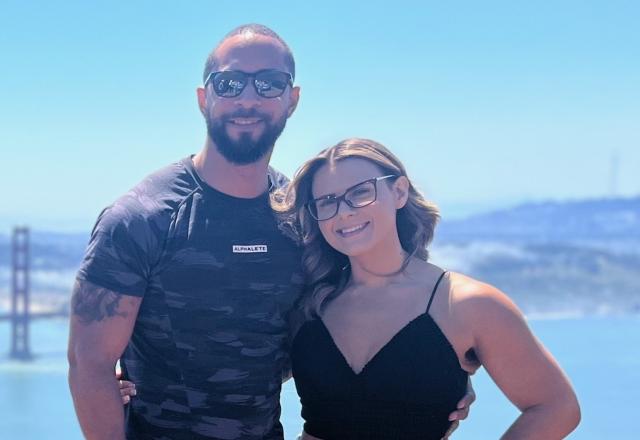
Cole spent about a decade with the United States Park Police, including service in the San Francisco area. The fast-paced urban environment exposed him to a wide range of incidents and helped develop the situational awareness, decision-making and problem-solving skills he still relies on today.
Those skills followed him to the BLM, even though the environment changed dramatically.
Urban policing taught him to quickly assess a situation, prioritize problems and act with the information available. BLM law enforcement requires the same foundation while adding greater distances, fewer immediately available resources and a higher level of self-sufficiency. The setting has changed, but the responsibility to recognize a problem, make decisions and act when someone needs help has not.
With the BLM, the distances are often greater, immediately available resources can be fewer, and self-sufficiency becomes even more important.
A routine patrol can quickly become a search and rescue, medical emergency, vehicle accident, welfare check or serious law enforcement response.
Cole has also assisted other agencies on traffic stops and responded to active-shooter incidents during his career.
“We never really know what the day has in store for us,” he said.
Although Cole prepares to operate independently in remote areas, he is quick to emphasize that first response on public lands is rarely a one-agency mission.
Self-sufficiency does not mean working alone.
Interagency relationships are part of his everyday work.
During an emergency, he may coordinate with U.S. Customs and Border Protection, the U.S. Fish and Wildlife Service, conservation law enforcement officers, local police and sheriff’s departments, military aviation assets or other available resources.
For Cole, the priority is not which agency gets there first. It is getting someone there.
“In the desert, five minutes can matter,” he said. “If another agency has a first responder who can reach the patient five minutes before I can, I want that person responding. Conversely, if I’m closest, I’m going.”
A significant emergency may bring together personnel from several agencies approaching from different directions while aviation, medical evacuation or other resources are being coordinated.
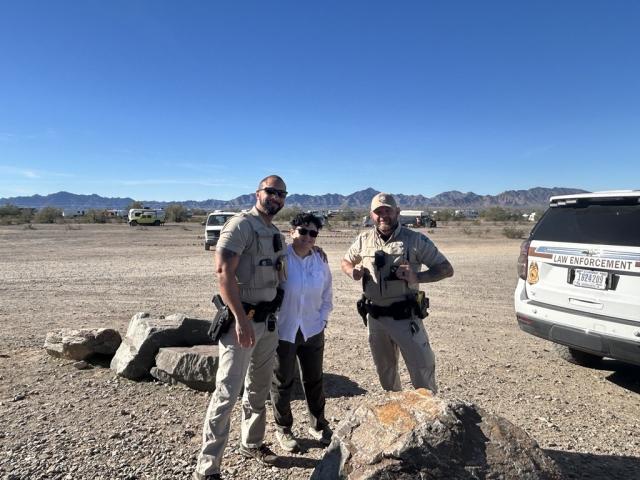
“Once an emergency begins, the patch on someone’s uniform becomes far less important than getting the right resource to the right place as quickly as possible,” Cole said.
Cole’s work requires law enforcement training, medical knowledge, backcountry experience, specialized equipment and the ability to make decisions under pressure.
But when asked what skill matters most, he points to something less technical.
People skills.
Most visitors will never interact with a BLM law enforcement ranger. When they do, Cole knows that interaction may shape how they view not only him, but the BLM and federal law enforcement more broadly.
“Even when someone is doing something they shouldn’t be doing, I believe in treating people with dignity and respect,” he said.
Spending years among the people who use public lands has also shaped Cole’s own perspective.
In the Quartzsite area, tens of thousands of visitors spend extended periods on BLM Long-Term Visitor Areas. Some have returned for decades, often camping in the same areas year after year. They know their neighbors, organize activities and look out for one another.
“From the outside, someone might simply see people camping in the desert,” Cole said. “When you work there and get to know them, you see a community.”
Those relationships are part of what he values about the job.
His office is America’s public lands.
“People take time off work, spend money and plan trips to visit places that I have the privilege of working in every day,” Cole said.
But the greatest reward, he said, comes from knowing his presence can make a tangible difference for someone, whether that means rescuing a person during an emergency, protecting a public resource or simply helping a visitor figure out where they are and where they need to go.
Cole’s career has taken him from fast-paced urban federal law enforcement with the U.S. Park Police to remote desert landscapes with the BLM.
Along the way, he received the Department of the Interior Medal of Valor, an honor that is particularly meaningful to him because it connects his service across both agencies.
Still, Cole does not view recognition as the reason first responders do their jobs.
“You respond because someone needs help and because that’s the responsibility you’ve accepted,” he said.
National First Responders Day provides an opportunity to recognize that responsibility and the people willing to accept it.
For Cole, it may begin with something as ordinary as climbing into a patrol vehicle and starting another day on public lands.
He does not know whether that day will bring routine visitor contacts, a stranded motorist, an injured hiker, a missing person, a resource crime, a medical emergency or a call to assist another officer.
He only knows he must be ready.
After years with two Department of the Interior law enforcement agencies and across vastly different landscapes, Cole has distilled that responsibility into a simple mission:
“Protect people, protect the places entrusted to us and be ready to respond when someone needs help.”
Related Content
Related Stories
- Celebrating 30 Years of California Condor Recovery at Vermilion Cliffs National Monument
- Using Beavers as Partners in Riparian Habitat Restoration in Las Cienegas National Conservation Area
- BLM recruits future workforce at Missouri University of Science and Technology career fair
- Nails and Tires Don’t Mix
- Signs of Collaboration: Protecting Tortoises on Arizona Public Lands
Office
7341 E. 30th St.
Yuma, AZ 85365
United States