


From Open Rangeland to Historic Battlefields
CROW AGENCY, Mont. — The Bureau of Land Management Wild Horse and Burro Program manages and protects wild horses and burros on public rangelands across 10 Western states.
These animals require active management because they have no natural predators and herds can quickly outgrow available water and forage. To maintain healthy horses on healthy rangelands, the BLM reduces herd sizes when they exceed what the land can support.
These gathered animals are placed into private care through its national adoption and sales program. They get a second life as personal saddle horses, trail companions, —even historic reenactment mounts.
June marked a major milestone in American history as descendants, historians, reenactors and equestrian enthusiasts gathered in Montana to commemorate the 150th anniversary of the Battle of the Little Bighorn.
Over 19 tribal nations were represented, and the National Park Service was prepared to receive more than 10,000 visitors during three days of commemoration activities. The Little Bighorn National Battlefield waived standard fees and operated an off-site shuttle system from nearby parking areas to get visitors up to the yet-to-be-completed visitor’s center and the national cemetery.
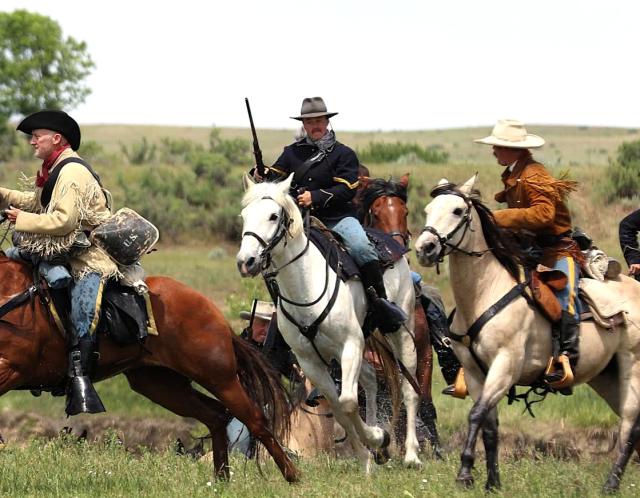
The U.S. Cavalry School camps on the bank of the Little Bighorn River each year across from the mouth of the historic Medicine Tail Coulee, a significant site in the battle’s story. The school offers hands-on experience, bringing together history lovers and horses to ride the battlefield and live a trooper’s life in the frontier Army.
Among the mounts traversing the rolling hills and river crossings of the battlefield were former wild horses adopted through the BLM program. These mustangs proved that with proper gentling and training, wild-born horses can handle the heat, gunfire and close-order formation riding required of a cavalry mount from the Old West.
Grace Thompson: Building Partnerships and Trust
For Grace Thompson, is a full-time horse trainer who starts and gentles wild horses through her business, G.E.T. Horsemanship (Gentle, Effective, Thorough methods). Working with mustangs is a lifelong passion. From her farm in Chattanooga, Tenn., she has been directly involved in prepping these adoptees for new homes.
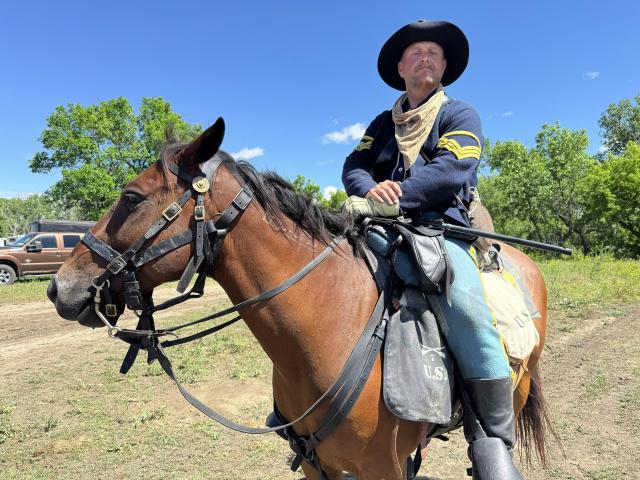
"Wesley was my very first mustang. I adopted him in 2018 for my first Youth Extreme Mustang Makeover," Thompson said. "Pryor was my first adult mustang. I adopted him in 2019 for the Players’ Choice Extreme Mustang Makeover and purchased him at the end of the competition."
Thompson has worked with Wesley since he was 10 months old, while Pryor was 3 years old when she acquired him. Both horses live on her farm.
"Both of these guys are incredibly laid-back," Thompson said. "They handle pressure well and thrive on clear understanding and good leadership. Wesley is my primary bareback and bridle-less horse, while Pryor is my main mounted-shooting horse."
At this year's 150th anniversary event, Thompson served as a corporal in the school. She said her primary training goal for the season was preparing both horses to serve as rental mounts for other participants. Pryor was assigned to Quartermaster Sgt. Chris Hoffert of Helena, Montana. Wesley carried squad leader Cpl. Tim Tellgren.
"Pryor was assigned to Quartermaster Hoffert, who needed a confident horse that could step away from the other horses while he taught classes, pointed out landmarks, and helped students visualize different scenarios," Thompson said. "Wesley was assigned to Corporal Tellgren, who served as a squad leader. Wesley handled the role incredibly well."
Thompson noted that while she was once unfamiliar with wild horse management as a young adult, her perspective shifted completely after gentling her first mustang.
"One of the biggest things I’ve learned is that, at the end of the day, mustangs are just horses," Thompson said. "They may start their journey with a different set of experiences than a domestic horse, but with patience, consistency, and good training, they can become incredible partners. Compared with a domesticated horse, these guys have so much more heart and drive to serve."
Tim Tellgren: A Veteran Rider's First Mustang Experience
Tim Tellgren, a retired information technology project manager and retired U.S. Air Force Reserve historian, hails from the San Antonio area. He has been studying the Plains Indian Wars for more than 50 years.
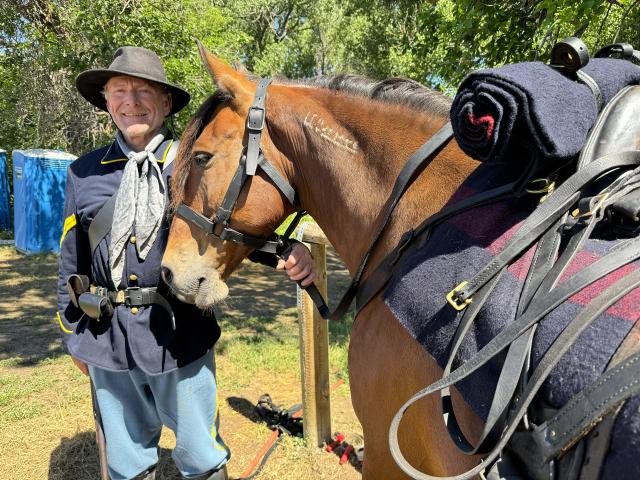
While he owns a horse back home and is an experienced rider, the long distance to Montana means he typically rents a horse for use at the school. This year marked his first time riding an adopted mustang at the event. The corporal was paired with Wesley on the recommendation of Thompson after initial rider evaluations.
"It's hard to describe, but I just felt safe and confident with Wesley right from the start," Tellgren said. "Grace warned me that he could be 'watchy' with new things, and he was—but not excessively. Even when a volley of rifle fire went off next to him or a group of warriors came running their horses at us, he never lost his mind."
Over the course of eight days, Tellgren rode Wesley through formation drills, river crossings, gunfire conditioning and reenactments. Their longest trek covered 14.2 miles from the Wolf Tooth Mountains past the Morass — another battlefield landmark — lasting about eight hours over rugged terrain.
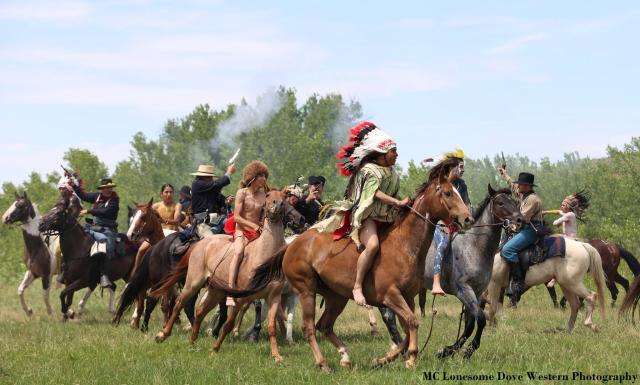
During the battle reenactment on June 25, Tellgren and Wesley served in the rear guard along Deep Coulee when Native reenactors mounted a fast-moving charge.
"They blasted right through us, but we were firing our pistols. Then our dismounted troops fired a volley with their carbines, and it was right next to us!" Tellgren said. "Wesley jumped sideways pretty hard, as did most of the horses, and then we were off running after the warriors and firing our pistols until they were empty, or the warriors were out of sight. It was very fun, very exciting."
Tellgren noted that Wesley's size and physical presence made him a focal point for visitors after the events wrapped up.
"Wesley is big and handsome, so he was a magnet for spectators," Tellgren said. "He has a very thick mane that covers his mustang brand, and I would always move it over and point out to the spectators that he was a mustang. They were always impressed and usually wanted a photo of themselves with Wesley with his brand showing."
For Tellgren, riding an adopted wild horse across the Montana landscape added a unique layer of meaning to the anniversary.
"I just feel so fortunate to have ridden such a fantastic mustang as Wesley at the 150th anniversary of the Little Bighorn battle," Tellgren said. "To ride a mustang—a horse that captures the mystique of the West—over such a magnificent landscape that is so packed with history and meaning? I can't imagine it being any better!"
The ‘Green on Green’ Beginning
When Maxwell Mihalis first took on Arriflex — a 4-year-old BLM mustang adopted wild by Mihalis’ mentor, Tasha — neither horse nor rider, was an expert in the process.
Mihalis splits his time between working as a cowboy in Wyoming and working in the film industry in Georgia. Arriflex was the first unstarted horse he had worked with, kicking off a learning curve for both.
Bringing the 6-year-old gelding to Montana for the 150th anniversary was a major milestone — a culmination of two years of groundwork and saddle time. Arriflex stepped up to the task quickly at the school, riding solid in formation and settling in despite new tack and unfamiliar surroundings.
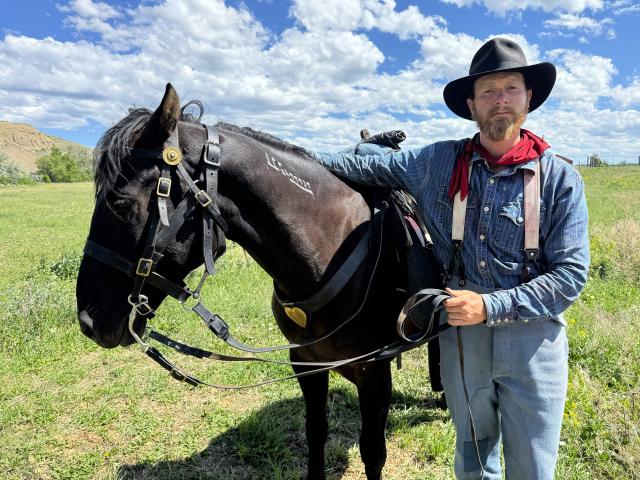
"He performed very well throughout the week of Cav School," Mihalis said. "He got a little spooky during the Sioux engagement in the hills earlier in the week, but he stayed manageable. He really settled in and mellowed out."
For Mihalis, the 150th anniversary was an unforgettable step on Arriflex’s long journey toward becoming a seasoned mount.
"We'd go out on campaign, with troopers and horses splitting into two massive platoons in the hills across the river, and you were really there. You could look all around and not see a single sign of modern life. I wouldn't trade that experience for the world," he reflected.
Now back home in Georgia, Mihalis has a long-term vision for the gelding: "I plan on bringing him to smaller Civil War reenactments over time; one day he'll make a real career war pony," he said.
Summer has passed and the year is moving on. Next June, the school, students, and horses will camp again on the Little Bighorn to catch a whiff of history. And the mustangs — with their heritage and spirit — will be there, too.
Related Stories
- National Public Lands Day Volunteers Revitalize Dean S. Reservoir in Montana
- Nails and Tires Don’t Mix
- Pipestone Roars to Life as Community Comes Together for National Public Lands Day
- Healing Hooves: How a Once‑Wild Burro is Bringing Joy Across Pennsylvania and Competing Nationally
- Gallant: A BLM mustang with a bright future