


One Mile Closer
“It is encouraging to see so many people show up on a summer Saturday, the first day of hunting season even, to put in hours of physical labor with the only goal of benefiting public lands.”
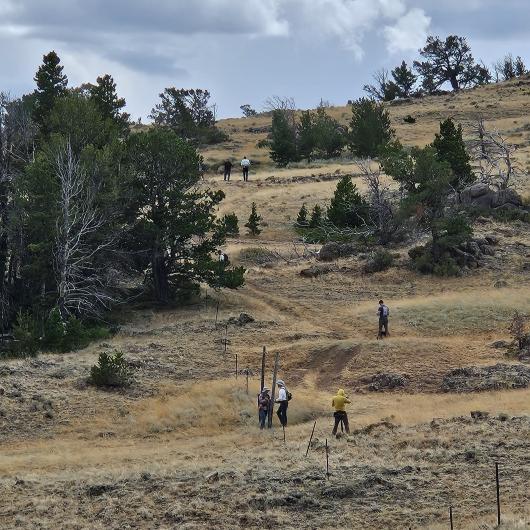
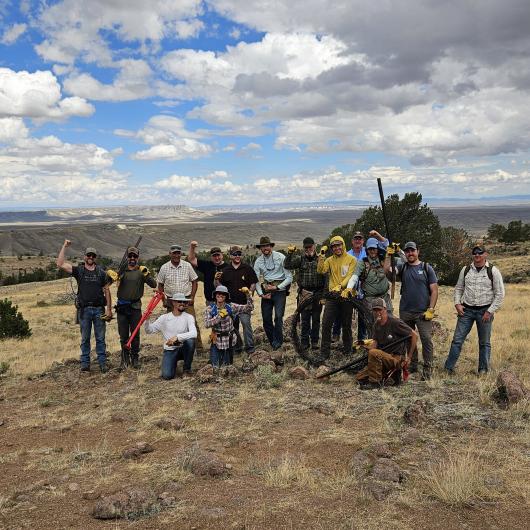
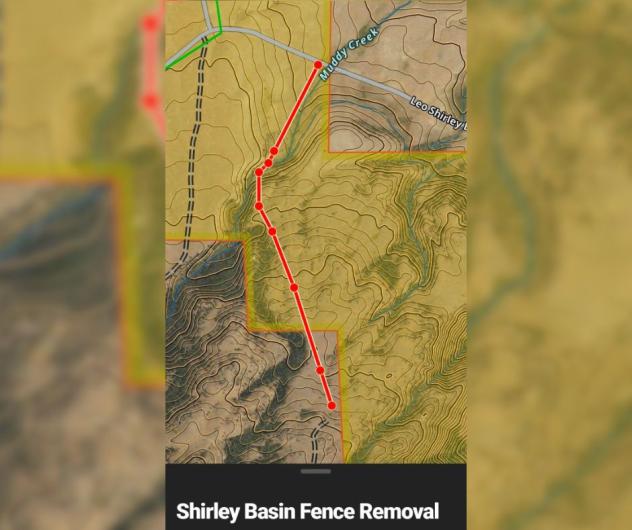
That’s how Pete Madsen, Montana habitat stewardship coordinator for Backcountry Hunters & Anglers, described the scene in August, when 15 BHA volunteers and two BHA staff members gathered in the Shirley Basin, west of the Rawlins Field Office, to remove one mile of old fence from the Sullivan grazing allotment near Prior Flats Campground.
Volunteers came from Casper, Lander, Jackson, Cheyenne, Rock Springs and Wheatland. Two staff members made the long drive from Idaho and Montana. The group camped at Prior Flats Campground the night before, so by sunrise Saturday, everyone was already on site and ready to work.
The fence had been there since the 1970s, built as a drift and pasture fence, but it was no longer needed for current livestock management. After decades on the landscape, the fence was in poor condition and had become more of a hazard than a help, posing an entanglement risk to wildlife moving through the basin.
The volunteers split into several crews to take down the barbed wire strand by strand, rolling it up for removal, and then pulling t-posts out of the ground. Almost all of the work was done by hand. The fence line crossed a dry creek bed and continued uphill, adding to the challenge.
“The work went smoothly. The volunteers all had fun and were smiling at the end, ready to do more,” Madsen said.
By the end of the day, the group had removed exactly one mile of fence and loaded more than 3,000 pounds of steel fencing material into a dump trailer for recycling.
The volunteers’ work—caring for a place they use and value, working alongside BLM employees and partners, and producing a visible benefit for wildlife—is the kind of connection All Americans Outside seeks to strengthen. The BLM-wide initiative helps more Americans find meaningful ways to explore, learn, serve and work on public lands.
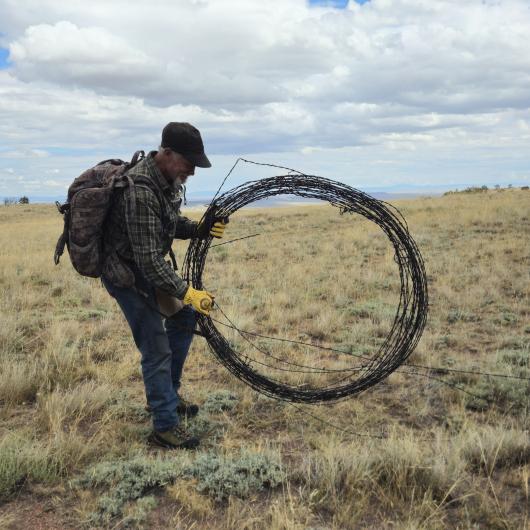
Mike Murry, a rangeland management specialist with the BLM’s Rawlins Field Office, served as project lead. The Sullivan grazing allotment is one of several Murry administers, putting him at the center of the work on the ground.
“The removal of unneeded livestock control infrastructure has a huge benefit to wildlife and their natural movements across the landscape,” Murry said. “It can reduce daily, seasonal and even migratory movement impacts to wildlife depending on the residency of the animals.”
The stretch of fence sits in habitat used by the Platte Valley mule deer herd, along with elk, pronghorn and sage-grouse, and volunteers didn't have to look far to see why the work mattered. Pronghorn moved through the area throughout the day, and the crew spotted mule deer and sage-grouse nearby as they worked.
“Obsolete fencing presents an unnecessary obstacle for wildlife to move throughout the landscape to access habitat, and a risk of injury or death to birds and animals when crossing,” Madsen said. “Removing old fences that are no longer needed means easier access to habitat for wildlife and reduces the risk of injury associated with crossing fences.”
There's a practical upside for the BLM and grazing permittees too. Less fence to maintain means less time and money spent on infrastructure that is no longer needed, Murry said, freeing up resources for other priorities.
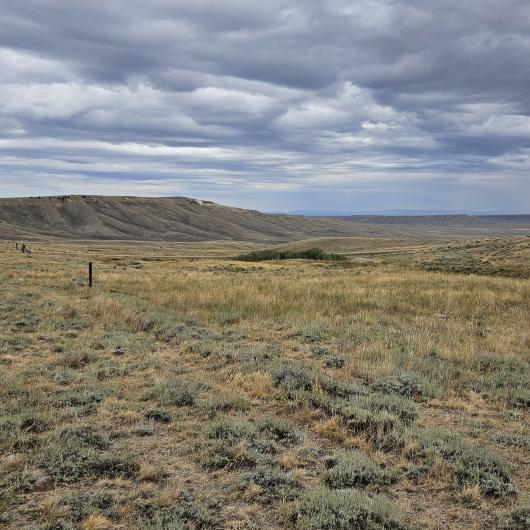
One mile of fence might not sound like much next to what’s still out there. But it’s a small piece of a much larger effort to remove unneeded fencing throughout the Shirley Basin. The BLM has identified another 20 to 25 miles of similar fencing throughout the area, on both public and private land, for future removal. The BLM and the Wyoming Game and Fish Department have also been converting other stretches of fence in the area to wildlife-friendly designs for pronghorn, and this project fits into that same push.
None of it would have happened without a partnership that started well before anyone picked up a pair of wire cutters. Mary Read, a wildlife biologist with the Rawlins Field Office, worked with Madsen to put together a partnership project proposal that eventually brought BHA’s volunteers out to the Shirley Basin. It was the first project the Rawlins Field Office completed with the Wyoming chapter of BHA, but not the organization's first project with BLM Wyoming. BHA has partnered with BLM Wyoming on several other stewardship projects, including a recent fence modification project with the Cody Field Office at the McCullough Peaks Herd Management Area. BHA also received the BLM’s Conservation Partner of the Year Award in 2025 for its stewardship work.
Murry said having an experienced group of volunteers who arrived prepared and needed little direction made all the difference.
“This is a very abled group of volunteers,” he said. “They completed the work faster than I had intended, with no direct supervision. They were well prepared and provided their own equipment and tools. Coordinating the proposed project was easy, as they appear to have completed much of this type of work across the state. And they are excited to help with more work in the area.”
That kind of experience matters, because projects like this one aren’t easy for BLM to pull off alone.
“It's very difficult for the BLM to complete some of these projects in-house, as we lack the manpower and time,” Murry said. “Working with non-governmental organizations makes these projects a possibility.”
Working alongside BLM employees also gave BHA volunteers a chance to connect with the people managing public lands.
“Engaging with BLM staff makes volunteers feel connected to the agency and people managing our public lands,” Madsen said.
Murry said the volunteers had an impact on BLM employees, too.
“We spend countless hours in the field documenting the landscape and the impacts of our management,” Murry said. “It's a huge workload to improve our public landscapes, and at times it seems overwhelming. The energy provided by a group of volunteers is very inspiring and the perfect motivation to make us want to continue these important efforts.”
For BHA members, projects like this also offer a way to give back to the public lands they use and value.
“Being good stewards of our public lands is a point of pride for many BHA volunteers and members,” Madsen said.
One mile of fence is now gone, but another 20 to 25 miles remain on the list for removal in the Shirley Basin. Both BHA and the Rawlins Field Office are interested in continuing the partnership.
“There is nothing more inspiring, as a public land manager, than working with a group of volunteers,” Murry said.
Madsen put it simply: “It feels good to all be working together toward a common goal that sometimes seems insurmountable, and projects like this are a great reminder that good things are being done, and we are now one mile closer.”
Interested in giving back to public lands? Visit All Americans Outside to learn about ways to serve and connect with BLM-managed lands.
Related Stories
- Celebrating National Public Lands Day across the High Desert District in Wyoming
- BLM recruits future workforce at Missouri University of Science and Technology career fair
- Nails and Tires Don’t Mix
- Fossils, furs and a few sparks at Kemmerer Outdoor Discovery Day
- BLM National Public Lands Day tradition continues in Roswell, New Mexico
Office
1300 North Third
PO Box 2407
Rawlins, WY 82301-2407
United States